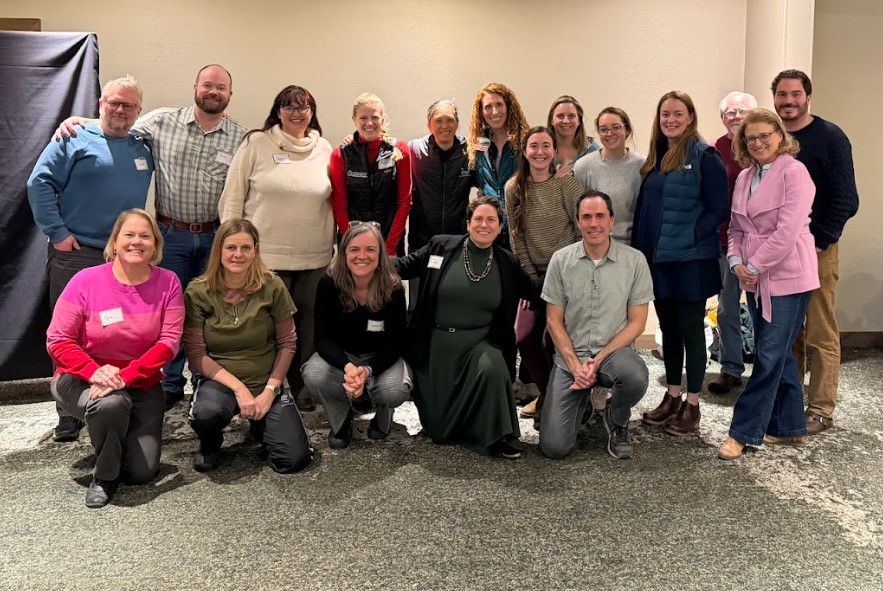
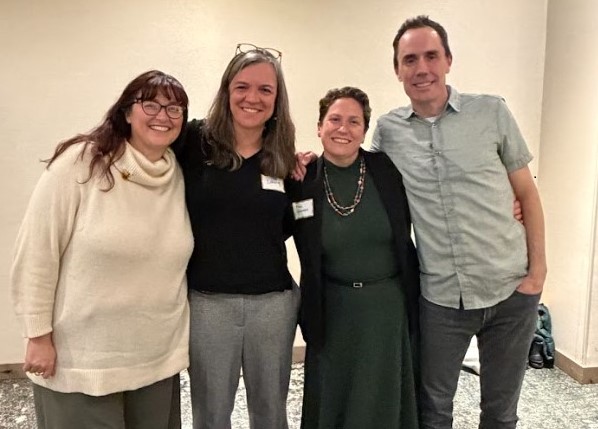
Montana WWAMI faculty gathered in Missoula last month for an evening of connection and practical skill-building during a Faculty Development Session sponsored by the Center for Learning and Innovation in Medical Education (CLIME). The focus was a familiar and often challenging topic: working with struggling learners.
Chris Jons, MD, Montana WWAMI Missoula Track Director, acknowledged that while the majority of students excel, some require additional support.
“Most WWAMI students are excellent, though occasionally we work with students who need extra support or aren’t meeting the expectations of their clerkships,” Dr. Jons said. “Many of us don’t feel like we have the skills to effectively reach these students and may not know where to turn for help. Faculty appreciated the support this session provided!”
A key theme was grounding teaching and evaluation in core competencies and School of Medicine program objectives, known as Medical Education Program Objectives (MEPOs), as third-year clerkships move toward competency-based medical education (CBME) with pass/fail grading. Dr. Jons said the shift encourages faculty to focus on specific skills and observable behaviors, placing their teaching within the broader trajectory of students’ development across the clinical years.
He emphasized that when faculty clearly identify behaviors through the lens of core competencies, they can offer more meaningful feedback and provide Clinical Competency Committees (CCCs) with the information needed to support students throughout their clinical training.
Laura Goodell, MD, Stern Regional Faculty Educator and Academic Co-Chair of the UWSOM (University of Washington School of Medicine) Curriculum Committee, helped guide participants through mapping observed behaviors to the four core clinical competency domains assessed through workplace-based assessments (WBAs): Professionalism, Patient Care, Interpersonal & Communication Skills, and Medical Knowledge.
“Observe specific behaviors, document in WBAs, provide feedback & support to the student,” Dr. Goodell said.
Participants also received a detailed “Missoula Learners in Difficulty” handout outlining documentation strategies, competency mapping and available support resources.
Dr. Goodell emphasized that accurately diagnosing concerns within specific competency domains allows faculty to tailor feedback and support to each learner’s needs.
“It is important to diagnose the learner in terms of competencies and areas for growth,” she said. “This will be unique to each learner. Preceptors can map their progress using specific benchmarks from each of the four clinical competency domains.”
The session also underscored the importance of early intervention and clear pathways for support.
“Intervene early and often! One major benefit of the switch to CBME is that grading decisions are no longer the responsibility of clinical teaching faculty,” Dr. Jons said. “This means the pressure and awkwardness of being the teacher and evaluator is removed. If we notice a student struggling, reaching out for support (to a colleague, regional clinical dean, clerkship director, or student affairs) will not be seen as an indicator that the student will not do well; but as a means to provide as much support as possible to help the student succeed.”
Dr. Goodell reinforced that faculty should not navigate difficult situations alone.
“If you encounter a learner in difficulty, don’t hesitate to reach out to your team for support and guidance – specifically clinical assistant deans: Dr. Serena Brewer and Dr. Jay Erickson,” she added.
Fiona Gallahue, MD, Professor and Residency Program Director Emeritus in Emergency Medicine and CLIME faculty member, reinforced the value of collaboration across the WWAMI region.
“I think the biggest takeaway from this session is that: ‘We are stronger together.’”
Dr. Gallahue noted that faculty may not always realize how much support exists across the distributed medical school.
“We have a huge network of leaders to help support clinical teaching faculty working with learners,” she added. “Because we are a distributed medical school, faculty do not always realize they have this support available. It’s so valuable for us to keep networking between our regional sites to build these relationships.”
By the end of the evening, Montana WWAMI educators left with practical tools, clearer frameworks and renewed confidence. Just as important, they left with stronger connections and a shared commitment to supporting every learner across the Montana WWAMI network.