
What if breast milk does more than just nourish a baby? What if it also helps to tell time, and improve an infant’s sleep and development, among other benefits?
Last month in California, Idaho WWAMI student Hannah Hardin’s research stood out among other medical students from across the Western United States for her impressive findings. The second-year student was recognized with the Abbott Nutrition Abstract Award at the 2026 Western Medical Research Conference (WMRC) for her outstanding work.
Her abstract, “Circadian Variation of Cortisol, Melatonin, and Cytokines in Breast Milk Compared with Infant Formula” explores how breast milk naturally changes over a 24-hour period and how those changes may support infant development.
“The research I presented at WMRC was on the variation of multiple bioactives in human breast milk throughout the 24 hours of a day to identify correlations with our circadian rhythm,” Hardin said.
She explained that breast milk contains hormones and immune markers that naturally fluctuate throughout the day and night, patterns that may help shape an infant’s sleep, stress response, and immune development.
“The makeup of human milk includes cortisol (a stress and wake hormone), melatonin (sleep regulation), as well as cytokines and immunoglobulins (inflammatory and anti-inflammatory markers) that have an impact on infants’ own sleep-wake cycles as well their neural, metabolic, and immune development,” she added. “I presented these findings in comparison with various U.S. and non-U.S.-based formula brands. We were able to quantify cortisol concentrations in these samples and as we know this is a static, or unchanging, feeding regimen throughout the day and night compared to human milk.”
The award was an unexpected and deeply meaningful honor.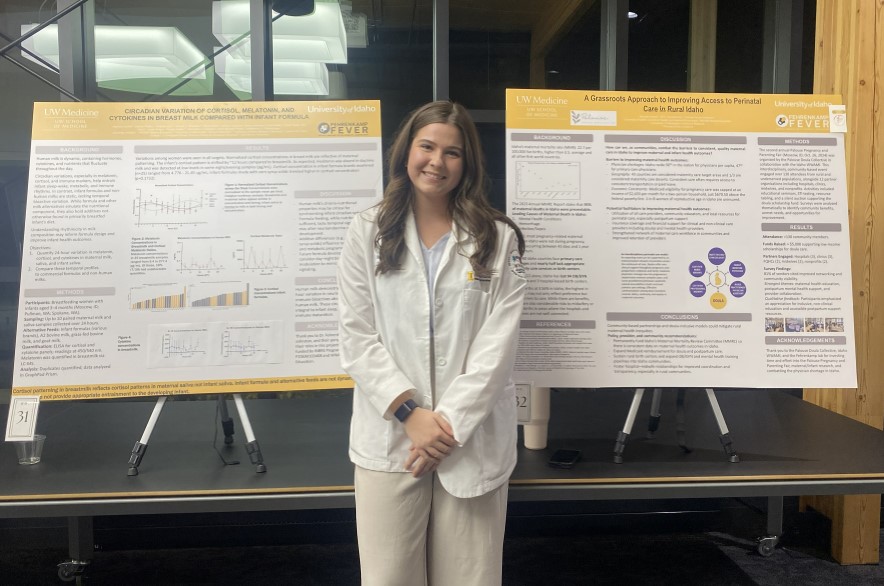
“I was surprised and very grateful for the recognition from WMRC and Abbott Nutrition,” Hardin said. “Getting to accept the award in person was a great opportunity to meet doctors and researchers in neonatology and neonatal nutrition who are doing amazing things and had valuable expertise to share.”
Hardin’s interest in women’s health and pediatrics began even before medical school and has deepened through her research experience.
“I have had an interest in women’s health, pediatrics, and preventive health since before medical school, likely from working in a family medicine and obstetrics clinic as a medical assistant,” she said. “There is so much we don’t know about the impact of infant nutrition on their health and development. This makes me all the more excited to continue research in this area.”
She also credits her mentor for helping make the work possible.
“I can’t go without recognizing Dr. Bethaney Fehrenkamp, the principal investigator and my mentor on this project,” Hardin said. “She shares my passion for women’s and infant health, and it has been a joy to work alongside her.”
Idaho WWAMI had a strong presence at WMRC, with 20 students presenting research across multiple disciplines.
Hardin’s award highlights the program’s growing impact in advancing research that supports mothers, infants and families — from the very start of life.