
UW Alpha Omega Alpha
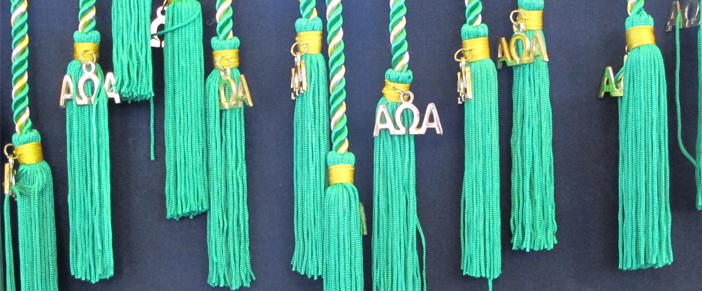
Alpha Omega Alpha (AΩA) is a national Honor Medical Society with over 120 Chapters around the country. Its purpose is to recognize and perpetuate excellence in the medical profession. Its mission statement is “AOA is dedicated to the believe that in the profession of medicine we will improve care for all by recognizing high educational achievement, honoring gifted teaching, encouraging the development of leaders in academia and the community, supporting the ideals of humanism, and promoting service to others.”
UW AOA Election Process
Read “How members Are Chosen” from the National AOA website to learn more about AOA eligibility, selection, and membership.
There are two opportunities for students to be elected into the UW Chapter of AOA: the Spring ‘Junior’ Election and the Fall ‘Senior’ Election.
About the Spring Election:
During the Spring election in April, up to 15 MS3 students are elected. The students are elected by current chapter members including MS4 students, faculty, and residents. Student eligibility information will be shared via the student newsletter by the chapter when the application process is beginning.
About the Fall Election:
During the Fall election in September, MS4 students are elected. The students are elected by the current chapter members: MS4 students, faculty, and residents.
What is considered for election:
Factors considered in elections are as follows: academic performance, research and publications, UWSOM involvement, leadership, community service, a lived experiences statement, and a character reference.
Student names are de-identified by a non-voting member of AOA before being reviewed by the AOA voting body. The chapter will elect members that exemplify strong scholastic achievement, utmost professionalism in medicine, leaders who set an example worth emulating, and those who have a high record of service in the medical school and community at large.
What actions do students need to take?
- To be considered for AOA, students must complete the AOA application before the deadline. Contained within the application are the grade release authorization*, the lived experiences statement, service and activities, and research and publications.
- In order for the school to adhere to the FERPA law and release your academic performance to the AOA chapter, students must sign an authorization form granting permission to do so. An email will be sent before each election about this.
- The UW chapter is requiring a short ‘Lived Experiences Statement‘ from each student eligible for AOA election. This is to provide additional or unique information/experiences that are not reflected elsewhere in the application.
*Elected student names are read aloud to the chapter, but at no point are names linked to the information listed above.
AOA Pearls of Wisdom
Each year, AOA members create the AOA Pearls of Wisdom document as part of their mission to serve the UW medical school community. The document represents a compilation of their advice to fellow students about how to succeed in the pre-clinical years, in clerkships, and during the residency application time. The document represents AOA students’ opinions, and as such, may or may not resonate with your experience in medical school.
AOA Peer Mentoring
Medical school can be hard – academically, physically, relationally, emotionally. Sometimes a little bit of wisdom and encouragement from those that have gone before you can be hugely helpful. With this in mind, the UW chapter of the Alpha Omega Alpha (AOA) Medical Honor Society has developed a program that facilitates mentorship between MS4 AOA members and interested pre-clinical and early clinical students. There are many potential reasons to seek an AOA mentor. Maybe you want to talk with someone matching into a residency that you are interested in. Maybe you want to connect with someone who has done research as a medical student in order to learn more about how that works. Maybe you just want to chat about what it takes to be healthy and successful during this crazy journey.
In the late fall a short survey will be sent out for those that are interested in pairing up with an AOA mentor. Based on this survey data, you will be matched with an appropriate mentor and connected via email. For those located in different cities than their mentor they can connect via phone, Zoom, and email.
Specialty Videos
Every year, AOA works with its members to gather advice and insights in order you get more information about each specialty and how you can be the most competitive applicant for that specialty.
Now, we have a catalog video collection of information for different specialties that will help you in your career discernment process! Don’t see a particular sub-specialty represented, let us know by contacting us or SOM career advising. Check out the available videos on the UWSOM AOA Specialty Video YouTube Channel.
Visiting Professorship
Every year, schools with an active AOA chapter are eligible to invite a visiting professor from another institution to speak about a topic of their choosing. This initiative aims to encourage clinicians to participate in new opportunities to educate students, residents and fellow clinicians. The visiting professor spends one full day of teaching and interacting with students, residents, and faculty. Additionally, the visiting professor is awarded a $1,500 honorarium by the national AOA for their election.
National AOA Programs for medical students
Carolyn L. Kuckein Student Research Fellowship
Helen H. Glasser Student Essay Award
Pharos Student Poetry Competition
Medical Student Service Leadership Project Award
Research Mentorship:
Alpha Omega Alpha annually conducts a survey in partnership with the III office to characterize current students’ research experiences. Responses from this questionnaire help connect future students to new mentors, grants/scholarships, and publication opportunities. In particular, AOA is interested in hearing from individuals involved in ongoing community/QI work, those who have found outside funding sources, and those who have attended academic conferences other than WSMRF.