
This week, we are highlighting results related to the quality of and overall satisfaction with UWSOM’s basic science education. As a reminder, the AAMC Graduation Questionnaire (GQ) is administered annually to graduating medical students.
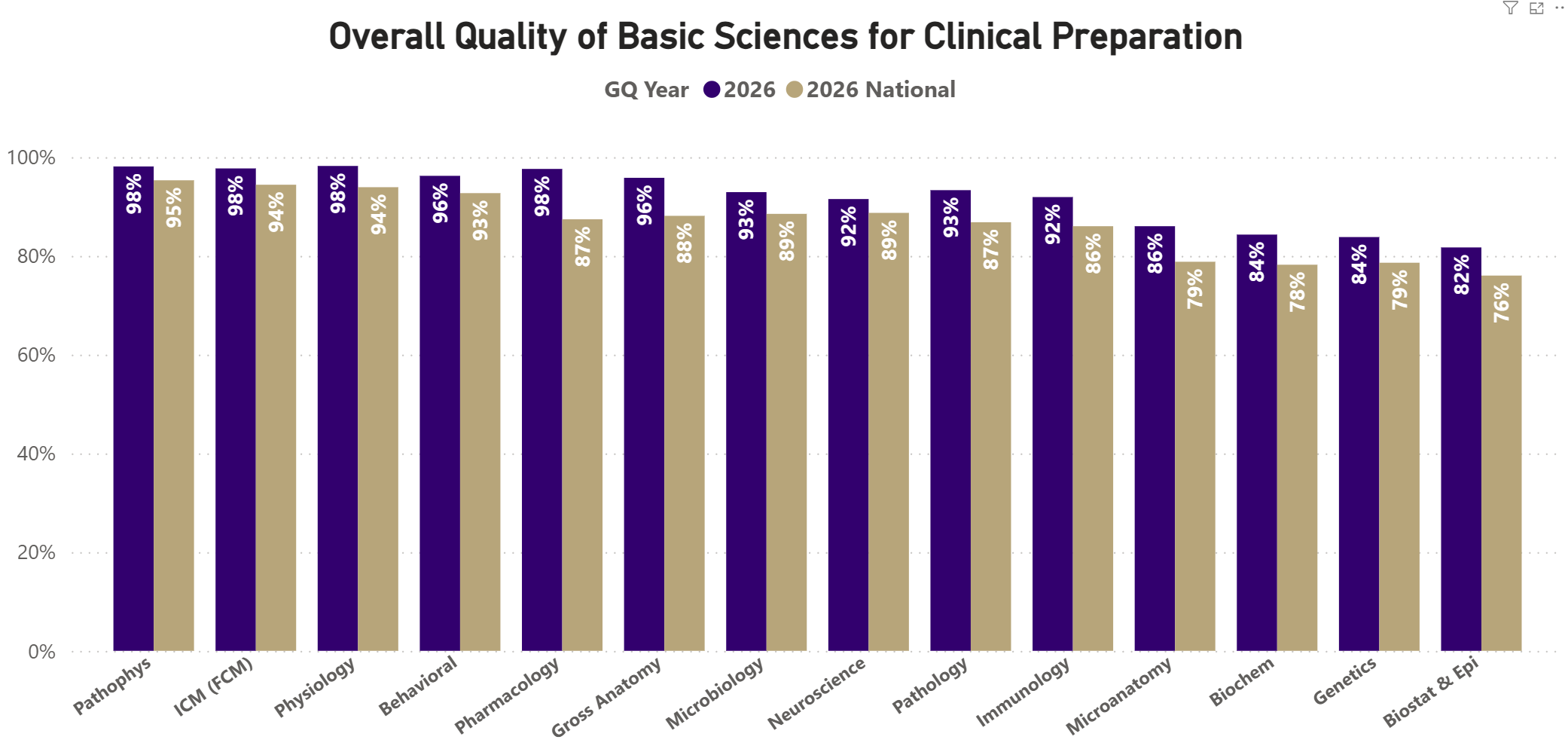
In an outstanding achievement, UWSOM scored above the national average in every basic science discipline included in the survey. Ratings were especially strong in pathophysiology, physiology, and pharmacology, with 98% of graduating students reporting that these disciplines prepared them well for clinical clerkships.
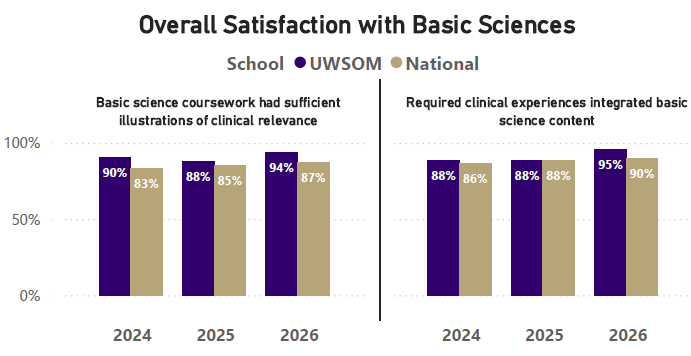
The results also reflect meaningful progress in connecting basic science concepts with clinical learning.
- 94% of students agreed that their basic science coursework included sufficient illustrations of clinical relevance—an increase of 6% from 2025 and 7% above the national average.
- Additionally, 95% agreed that their required clinical experiences integrated basic science content—an increase of 7% from 2025 and 5% above the national average.
These results highlight feedback from students on the strength of UWSOM’s basic science curriculum and the dedication of the faculty, staff, and students who continually work to enhance teaching and learning across the medical education program.
To build on this success, the curriculum team is advancing several initiatives:
- The Innovations in Curriculum Design and Delivery (ICDD) workgroup developed student-informed recommendations to further strengthen curriculum design and delivery across UWSOM’s regional campuses. These recommendations address priorities such as active learning, cross-course consistency, clinical relevance, and the integration of academic support.
- Student Block Partners from Seattle and the regional campuses gather feedback throughout each course and share recommendations directly with course directors. Through the “Lessons Learned” process, course directors identify planned improvements and communicate their responses to the full student cohort.
- Beginning with the E-26 class, Seattle introduced two longitudinal faculty members starting with the Infections and Immunity block. These faculty members teach small groups across all blocks, building on a model already used at several regional campuses. This approach provides students with greater consistency and allows faculty to develop stronger, more supportive relationships with students over time.