
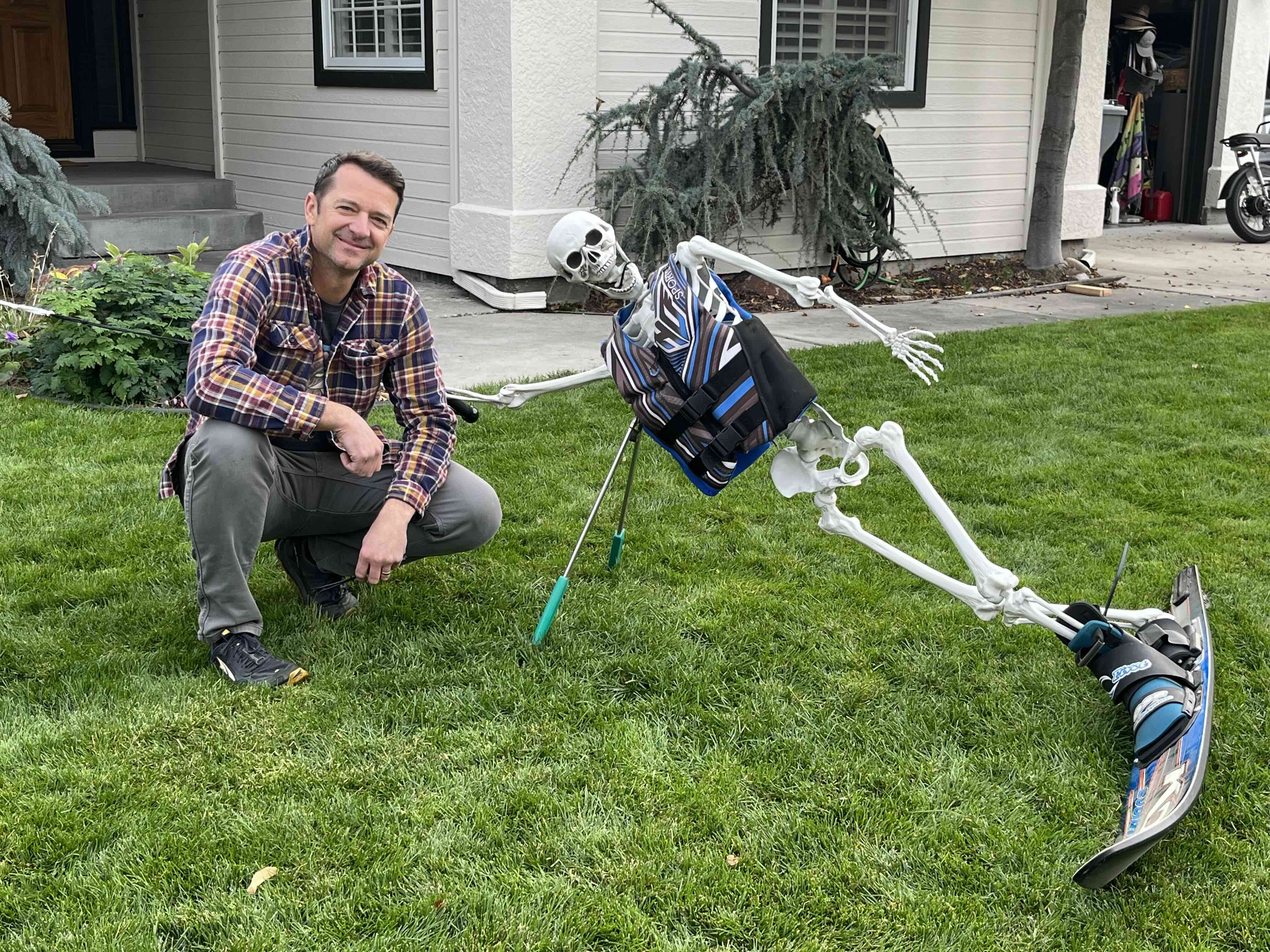
For Roger Turcotte, MD, the path to medicine ran through Idaho and back again. An Idaho native set on returning home to practice primary care, he made WWAMI his first choice for medical school. “As an Idahoan, I was committed to coming back to Idaho and I was interested in primary care, so WWAMI was the perfect fit,” he says.
While many of his classmates roamed the five-state region for rotations, Turcotte spent much of his training in Seattle. There he built a natural affinity for internal medicine at Harborview and the Seattle VA, where he found mentors who shaped his career. He completed residency in 2012 and put roots in Boise, where he still considers himself a true generalist.
Stepping into the void
Turcotte did not set out to focus on diabetes. But Boise, like much of the country, faced a persistent shortage of endocrinologists, and he was asked to help manage complicated cases. Insulin, by his own admission, was not an early strength.
“Sometimes focusing on a weakness is the best way to turn it into strength,” he says. Years at the St. Luke’s Humphreys Diabetes Center, where most of his patients had type 1 diabetes, taught him to manage insulin pumps, continuous glucose monitors, and the technologies now central to modern diabetes care.
Today he runs a large outpatient internal medicine practice. A significant minority of his panel lives with type 1 diabetes and tends to skew younger than the older adults with chronic conditions who make up most internal medicine caseloads, a mix that adds variety to his week. He sees patients three and a half days a week, spends a half day in the internal medicine residency clinic or on admin work as his clinic’s site medical director, and, even with AI scribes and a better EMR, still logs plenty of after-hours time chasing abnormal results, puzzling through clinical conundrums, and answering patient messages.
The hardest prescription in primary care
Turcotte has made insulin education a personal mission, and he is blunt about why it matters. “The rapid acting insulins that we ask patients to use before eating or to correct high blood sugars might be the most dangerous medications in common use in primary care, and we ask patients to adjust these medications on their own,” he says. Prescribing insulin well is difficult, he notes, and rarely taught thoroughly in training. So he teaches it, to students, residents, and anyone else who will listen.
He is just as direct about what patients carry. Most clinicians, he says, underestimate how hard day-to-day diabetes management really is. Stigma around type 2 diabetes persists, and patients often shoulder guilt and shame that the health care system itself has historically reinforced. That, at least, he sees improving.
A field on the move
Ask Turcotte what excites him, and the answer comes fast. “I think the field of diabetes care is unquestionably the most exciting in primary care, and possibly all of medicine,” he says. For type 2 diabetes, GLP-1 medications now treat both diabetes and obesity, with several tied to reductions in overall cardiovascular mortality. For type 1, automated insulin delivery systems pair pumps with continuous glucose monitors, and those benefits are beginning to reach selected patients with type 2 as well. None of it existed in anything close to its current form when he finished residency in 2012.
The patient who stayed
One story has stayed with him since the beginning. Fresh out of residency, splitting time between the hospital and clinic, he cared for a young woman with type 1 diabetes admitted to the ICU in diabetic ketoacidosis. She could not afford her insulin and had no primary care. He helped her get her insulin under control and took her on as a primary care patient. Fourteen years later, she uses an insulin pump, her diabetes is well controlled, and he still looks forward to seeing her in the office every few months.
Mentorship and advice
Over the years, Turcotte has worked with many WWAMI students, several of whom went on to internal medicine residency in Boise. One now works in his office. “The quality of WWAMI students over the years is always high,” he says.
For students drawn to endocrinology or diabetes care, he offers three pieces of advice. First, latch on to anyone with a passion for diabetes, especially the educators, dieticians, and behavioral health specialists who bring decades of experience and are always willing to share. Second, lean on continuous glucose monitors, which give clinicians the kind of high-quality feedback found almost nowhere else in primary care and can sharpen a motivated clinician quickly. Third, for the most interested, consider one of the one-year diabetology fellowships now available around the country, an option that did not exist when he trained.
Off the clock
Turcotte has more interests than time for them. Since residency he has been learning the piano, a pursuit his two teenage boys file under “old head.” Summers mean slalom water skiing,winters mean telemark, and year-round he makes a point of reading fiction.
He is clear-eyed about the state of the profession, and unshaken. “Talk of burnout dominates medicine these days, but it’s still a wonderful profession and a privilege to be a physician,” he says. “I would choose it again.”