
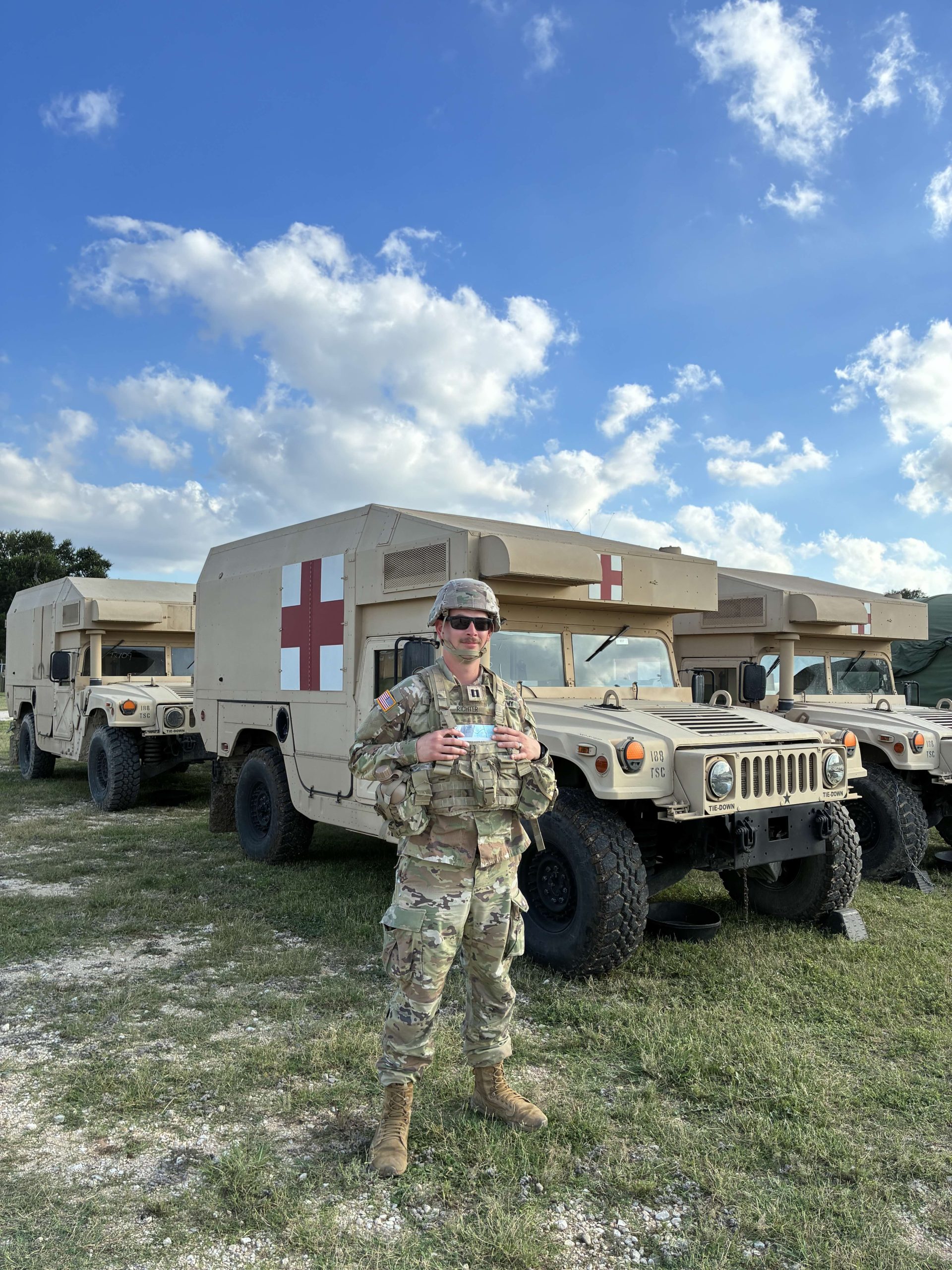
For Idaho WWAMI alum Jordan Richter, MD, the path to medicine began in uniform.
Richter and his family moved to Idaho in 2013. He was raised in a military-focused home and always expected to serve. After pursuing several different career paths, he decided the time had come and joined the Idaho National Guard as a medic.
“I had a desire to help others and felt that it would be a good beneficial skill set to have throughout my life,” he said.
Finding medicine through service
Working as a combat medic gave Richter his first real exposure to medicine, and it stuck.
“Being exposed to medicine as a combat medic made me realize how much I enjoyed learning about medicine and gave me a desire to pursue that education and service as much as possible,” he said.
That desire took hold quickly. Before he had even finished his initial medic training, Richter began applying to undergraduate universities to start the path toward becoming a physician.
A daily reminder in Moscow
Richter studied at the University of Idaho, home to Idaho WWAMI. Walking past the WWAMI building each day kept him motivated.
“It would be a constant reminder of what I was working towards to keep me focused throughout undergrad,” he said.
Getting to know current WWAMI students and professors showed him the strength of the program, and it quickly became one of his top choices for medical school.

While at the University of Idaho, Richter also commissioned as an officer in the U.S. Army through ROTC.
Prepared for residency and military medicine
Richter is now an intern in the Carl R. Darnall Army Medical Center (CRDAMC) Family Medicine Residency Program at Fort Hood, Texas. He credits Idaho WWAMI with laying the groundwork.
“The amazing education I received at Idaho WWAMI set me up for success and made me well prepared to start residency now in my intern year,” he said. “The variability of family medicine that I was exposed to during medical school has transferred well to the nuances of military medicine.”
Choosing a military residency was a natural next step given his existing commitment to the Army through the National Guard and ROTC. Family medicine was a deliberate choice.
“I chose family medicine due to its broad scope, and I wanted to have a close relationship with the military families that would be serving,” he said.
What service means
For Richter, service as a veteran and service as a physician are closely connected.
“There are few things in life that bring me as much joy as I feel when I am able to truly serve someone else,” he said. “I feel my military service is more of a duty that I have and must do my part to help defend this amazing country that we live in. I think that doing that as a physician is the best way to use the talents that I have been given to do the most good.”
A message this Veterans Day
Richter hopes readers will take time to recognize those who have served.
“Veterans Day gives us the opportunity to reflect on and thank those who have chosen to serve in the military, all of whom, when they signed their name, knew they were signing a blank check to give themselves and possibly their lives in the defense of this country,” he said. “Please take this day to thank those around you who have served and be grateful for the freedoms that we enjoy because of their service.”