
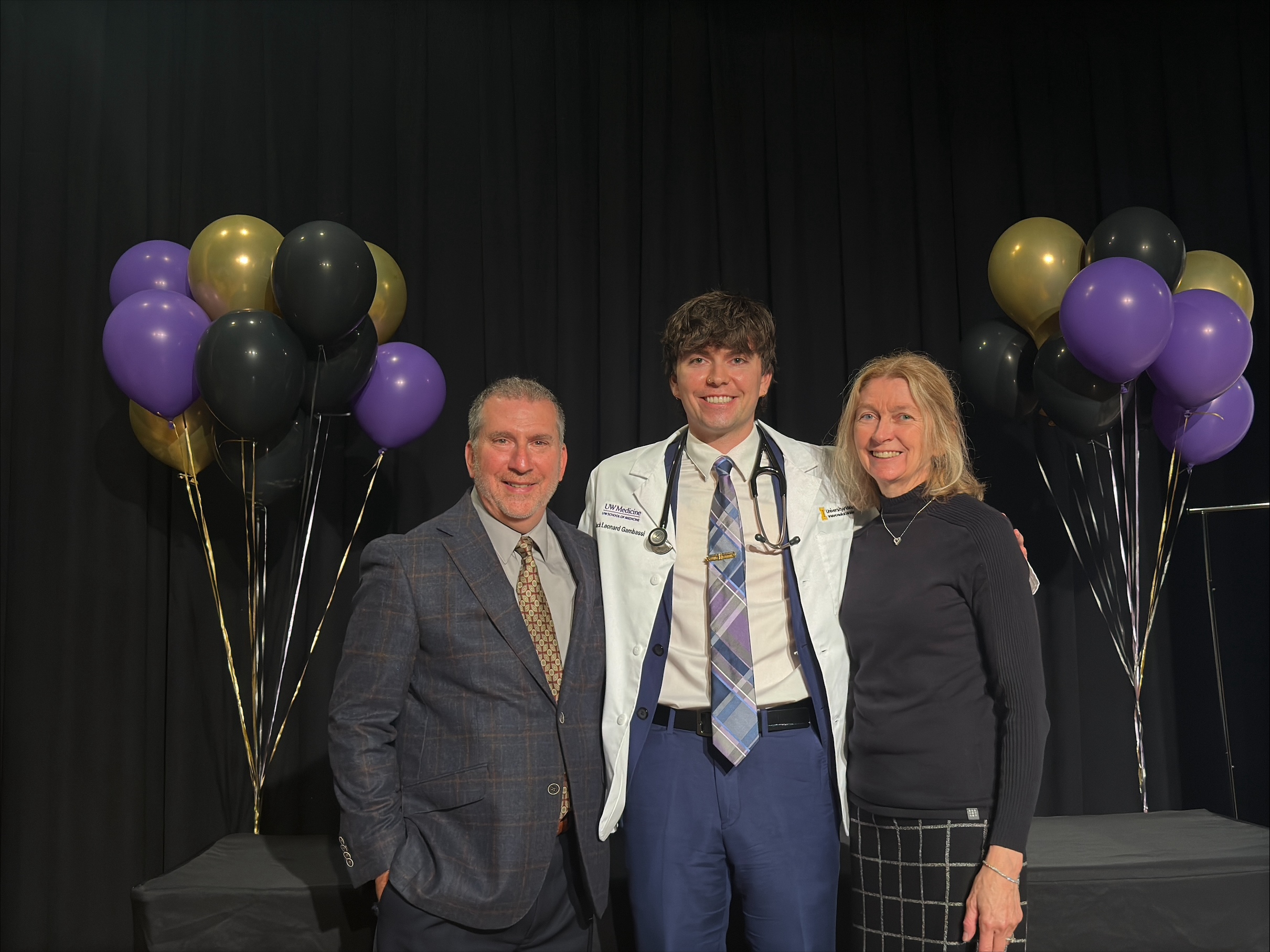

For Idaho WWAMI student Jack Gambassi, medicine didn’t begin in a lab or a lecture hall. It began at home in Boise, helping care for his two younger sisters.
Jack grew up in a family that encouraged his many interests. He played club soccer, played bassoon in the Boise Philharmonic Youth Orchestra, and spent time skiing, backpacking and fishing. “Boise was a wonderful place to grow up,” he said. “It offered a nice balance of opportunities to learn and get involved without getting so large that you lose the small-town feel.”
His sisters, Claire and Julia, were born eight weeks premature with global developmental delays. Years later, a geneticist identified their condition as cardiofaciocutaneous (CFC) syndrome, a rare spontaneous mutation in a key signaling pathway. People with CFC often need care from many specialists for heart defects, seizures, skin conditions and developmental therapy. For Claire and Julia, the seizures were the most difficult part. They returned around age 10 and, despite many medication combinations, rarely went a day without at least one.
Caregiving as a big brother
Jack helped prepare and give his sisters’ twice-daily medications, some of which had to be crushed and mixed. He braided their hair in the morning. As he got older and stronger, he carried them upstairs to bed, helped them in and out of the car and wheelchair, helped them dress, and worked with them on stretches and exercises from therapy.

“The caregiving felt second-nature to me and just part of my job as a big brother,” he said.
He says that caring for siblings who are non-verbal taught him the kind of attentiveness he’ll carry into medicine. “You can’t rely on them to tell you what is wrong, so you’re using everything else that you can notice, little details, to figure out what they want or how they are doing.”
His parents’ dedication also stayed with him. “There is no stopping. No days off of care. That kind of determination and tenacity is something that I hope to emulate in my own career.”
The view from the family side of the exam room
Jack often went along to his sisters’ appointments, and over the years the family’s relationships with their specialists grew into what he calls “a deeply caring community.” Their providers valued his input and answered his questions. He was the first to notice Claire’s first seizure as a child.
The care team communicated well despite the number of specialists involved, he said. His main frustration came when medications his sisters had taken for years suddenly required insurance prior to authorization, which caused shortages for the family.
Choosing medicine
At 15, Jack shadowed his sisters’ longtime pediatric cardiologist, Dr. Womack.
He later worked in clinics while studying at the University of Utah, where he double-majored in economics and worldlanguages and cultures. Still, medicine felt uncertain, and he began looking for jobs in economics.
Then, in 2024, Claire was hospitalized, had emergency surgery, and, after several weeks in the ICU, passed away.
“Words are inadequate to describe the unexpectedness and grief of this for both me and my family,” Jack said. But being at the hospital during her care settled his decision. As her physicians helped the family shift the goal of her care from curing to comforting, he saw no drop in the team’s dedication. “It felt like that curative and medical layer had been peeled back, and I witnessed, unobscured, the essential compassion at the center of any effective care,” he said. “It demonstrated a missing piece of medicine for me that I needed to see before I could take the leap.”
Why Idaho WWAMI
Jack chose Idaho WWAMI for its regional training model and the flexibility to choose how much he rotates across settings, from remote rural sites to large academic medical centers and from Wyoming to Alaska. “I feel that getting a mix of care settings will make me a better physician in the future and prepare me better for any potential place I find myself,” he said.
He plans to pursue surgery, with a particular interest in reconstructive surgery and international partnerships that build educational and research infrastructure. He also notes that Boise has a large refugee community, and he could see himself caring for that population after training.
What he hopes clinicians understand
Jack wants clinicians to consider what caregivers can realistically manage, and to recognize that the same disability can call for different care depending on the person and their goals. “The best way to do that is to utilize the knowledge of the patient and their caregivers as the experts of the illness, and to incorporate them into the decision-making process,” he said.
To students whose path to medicine began with caregiving, he acknowledges that leaving for training can bring guilt, and he recommends finding someone to talk with about it. He also encourages them to reflect on what caregiving has taught them: “When you see a patient, think about ways that providers have made accommodations for your loved one and how to emulate that.”

Paying it forward
When Jack was 10, his sisters received a service dog, Zane, from Canine Companions, an organization that provides service dogs free to recipients. “That was truly a transformative moment for our whole family,” he said. His family went on to raise three puppies, Wave, Lustra and Ethel, for other people with disabilities.
“The feeling of handing over the leash to someone with a disability, and knowing how impactful that dog will be for them, is one of the greatest feelings I have ever experienced.”