
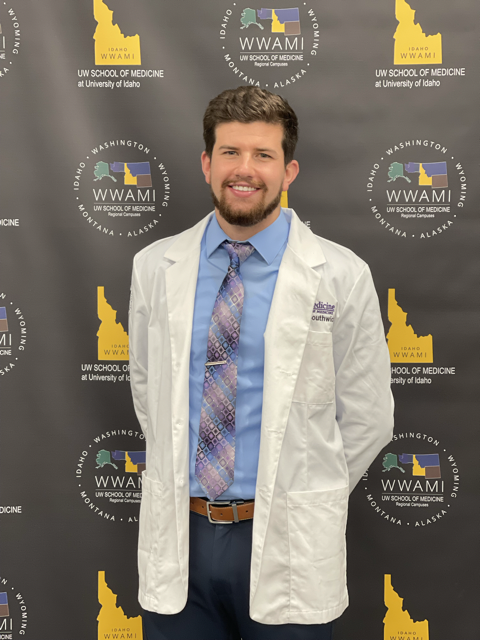
A first-week of medical school conversation with Dr. Mary Barinaga, Assistant Clinical Dean for Idaho WWAMI started then Idaho WWAMI first year medical student Derek Southwick on a path to the National American Academy of Family Physicians (AAFP) Board of Directors.

Now he wants to bring that experience back to Idaho Falls.
During his first week of medical school, Derek Southwick asked Dr. Mary Barinaga a simple question: How could he get involved?
That question led to a seat on the Idaho Academy of Family Physicians Board of Directors, national roles with the American Academy of Family Physicians (AAFP), and, in 2025, election by his fellow residents to the AAFP Board of Directors.
Today, Dr. Southwick (E20) is a third-year family medicine resident He graduated from the University of Washington School of Medicine: Idaho WWAMI in 2024. When he finishes residency in June 2027, he is coming home to Idaho Falls.
Medicine close to home
Southwick grew up in Idaho Falls, where his father is a family physician. Watching him practice shaped Southwick’s direction early.
“I saw the relationships he developed with his patients and the difference he could make in people’s lives,” Southwick said. “From a young age, I knew I wanted to follow a similar path.”
His brother, who had Duchenne Muscular Dystrophy, was another major influence. Seeing the challenges his brother faced sparked Southwick’s curiosity about medicine and the sciences, along with a desire to help people face similar challenges. As a high school senior, he organized a project through Coach to Cure to raise awareness and funds for Duchenne Muscular Dystrophy.

“Between my father’s example and my brother’s experiences, medicine became something much more personal than just a career choice,” he said.
Five states, one education
Southwick chose WWAMI for the UW School of Medicine’s reputation in primary care and family medicine, and for the chance to learn across a diverse region while staying connected to Idaho. He spent about his first year and a half in Moscow, Idaho, before clinical rotations took him to all five WWAMI states.
One favorite was an advanced family medicine rotation in Juneau, Alaska, with Dr. Richard Welling (E91 Alaska WWAMI), who showed him what comprehensive family medicine could look like, including home visits. Southwick was there in June. After clinic, he hiked the mountains, and some local physicians took him flying over the glaciers in their own planes.
“There was a real sense that medicine was part of their lives, but it didn’t have to be their entire lives,” he said.
An obstetrics rotation in Powell, Wyoming, couldn’t have been more different. His obstetrician preceptor’s dog wandered the office, and the physician occasionally rode his horse to work. Southwick also traveled about an hour and a half to provide care at another rural clinic.
He studied psychiatry at a major academic medical center in Seattle and otolaryngology in Jackson Hole, Wyoming.
“You learn that good medicine doesn’t look exactly the same everywhere,” he said, “and you develop an appreciation for how to adapt your care to the needs and resources of the community you’re serving.”
Real responsibility in Idaho
Some of Southwick’s most valuable experiences happened in Idaho. On his general surgery rotation in Caldwell with Dr. Ryan Hardy, he was the only learner in a community setting, with no other students or residents competing for cases.
He first assisted on more than 80 surgeries and performed more than 50 intubations, often moving between operating rooms to work with different surgeons.

“I wasn’t simply observing medicine,” he said. “I was actively participating in it.”
In Boise, his pediatrics rotation with the family medicine residency program covered newborn, inpatient, and outpatient care, plus time with pediatric subspecialists in gastroenterology and neurology and exposure to child abuse evaluations. He also completed internal medicine at Boise VA and spent time with the family medicine residency in Pocatello.
“Sometimes being the only medical student in a smaller community means you’re given more responsibility, more opportunities to perform procedures, and more direct mentorship,” he said.
He didn’t fully see the value of that training until residency, working alongside graduates from other medical schools.
“I began to recognize how much responsibility, procedural experience, and clinical exposure I had received as a medical student,” he said. “I would choose WWAMI again without hesitation.”
A question in the first week
Southwick arrived at medical school already set on family medicine. His father had served as president of the Idaho Academy of Family Physicians, so he knew students could get involved in organized medicine. He also knew Dr. Barinaga, Assistant Clinical Dean for Idaho WWAMI, was a strong advocate for family medicine in Idaho.
When they met that first week, he asked how to get involved. She encouraged him to attend the AAFP’s national conference for medical students and residents, now called FUTURE, and connected him with opportunities to represent Idaho. He went on to serve as the medical student representative on the Idaho Academy of Family Physicians Board of Directors, working alongside her.
“She didn’t just tell me about an opportunity,” he said. “She encouraged me to pursue it, helped connect me with people, and continued supporting me as I became more involved.”
“Dr. Barinaga opened doors for me, and I made it a point to keep walking through them.”
He credits other mentors across the region too. During a first-year rural preceptorship in Pullman, Washington, Dr. Stephen Hall showed him a broad procedural practice, including dermatologic procedures and dermoscopy, in an office with a positive, enjoyable atmosphere. Dr. Welling in Juneau and Dr. Hardy in Caldwell each left their mark, as did physicians in the Idaho Academy of Family Physicians, including Dr. Peter Crane, who hosted Southwick on the Doctors Making a Difference podcast.
“You’re not learning from just one group of physicians at one institution,” he said. “You’re learning from outstanding doctors across an entire region, each of whom has something unique to teach you.”
Leadership as service
From the state board, Southwick moved into national work. He represented Idaho in the AAFP’s student congress, served as a regional coordinator for Family Medicine Interest Groups, and took part in the AAFP Congress of Delegates as a national student representative.
When he noticed several western states weren’t sending student delegates to the AAFP’s national conference, he reached out to state chapters and helped recruit students. Eventually, students from all 18 western state chapters participated.
“You don’t necessarily need an established leadership position to make a difference,” he said. “Sometimes you just need to recognize a problem, take some initiative, and bring people together to address it.”


As a student, he also helped develop an initiative on language access in Idaho, focused on patients who couldn’t get prescription labels and instructions in their preferred language. A resolution on the issue was adopted by the AAFP Student Congress.
“Leadership, to me, is really just service,” he said. “If we want healthcare to improve, physicians need to be involved in leading that change. We can’t simply wait for someone else to make those decisions for us.”
His advice to WWAMI students curious about getting involved: just get started. Join your campus Family Medicine Interest Group, connect with your state academy of family physicians, and make attending FUTURE a priority early. He has attended every year since his first year of medical school.
“Don’t be afraid to introduce yourself, ask questions, and pursue opportunities that interest you,” he said. “You never know which conversation might change the direction of your career.”
Coming home to Idaho Falls
After residency, Southwick will join his father and his partners at Family First Medical Center, an independent family medicine practice in Idaho Falls.
He plans to build a comprehensive practice that draws on his procedural training, including colonoscopy and other procedures that can improve access to care for patients in Idaho Falls and surrounding communities. He also hopes to continue some inpatient hospital medicine and, longer term, to teach and mentor medical students or residents.
“My goal is to build a practice where patients feel known, respected, and cared for,” he said.
He plans to stay involved with the Idaho Academy of Family Physicians, advocate for physicians and patients, and support Idaho’s medical education and residency programs.
“Idaho invested in my education and gave me the opportunity to attend an exceptional medical school while gaining experiences throughout the WWAMI region,” he said. “Now, after spending several years training in Indiana, I have the opportunity to bring that education and experience back to the state that supported me.”
Looking back on that first-week conversation with Dr. Barinaga, he never imagined where it would lead.
“I’ve been fortunate to have people who believed in me, encouraged me, and opened doors that I didn’t even know existed,” he said. “As I return home, I hope I can do the same for others.”